
Last updated October 16, 2026
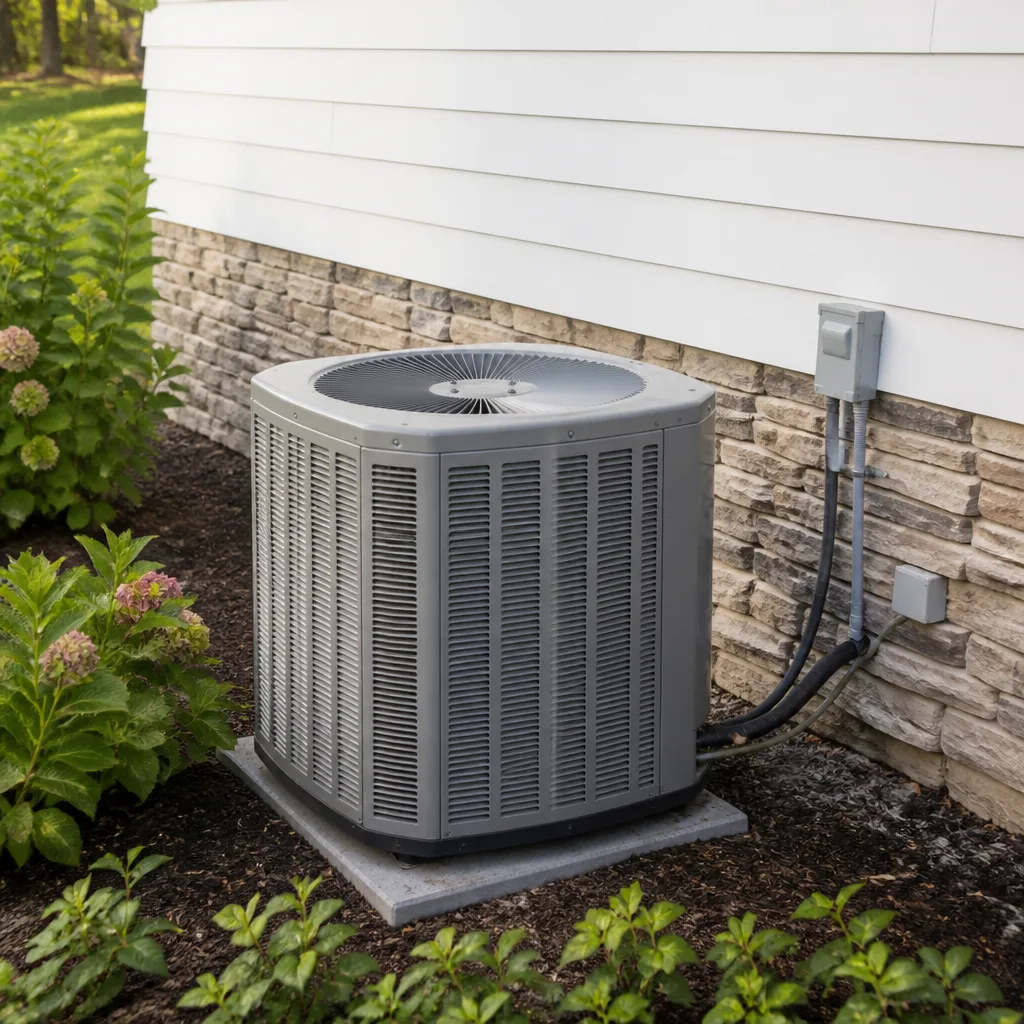 AC repair
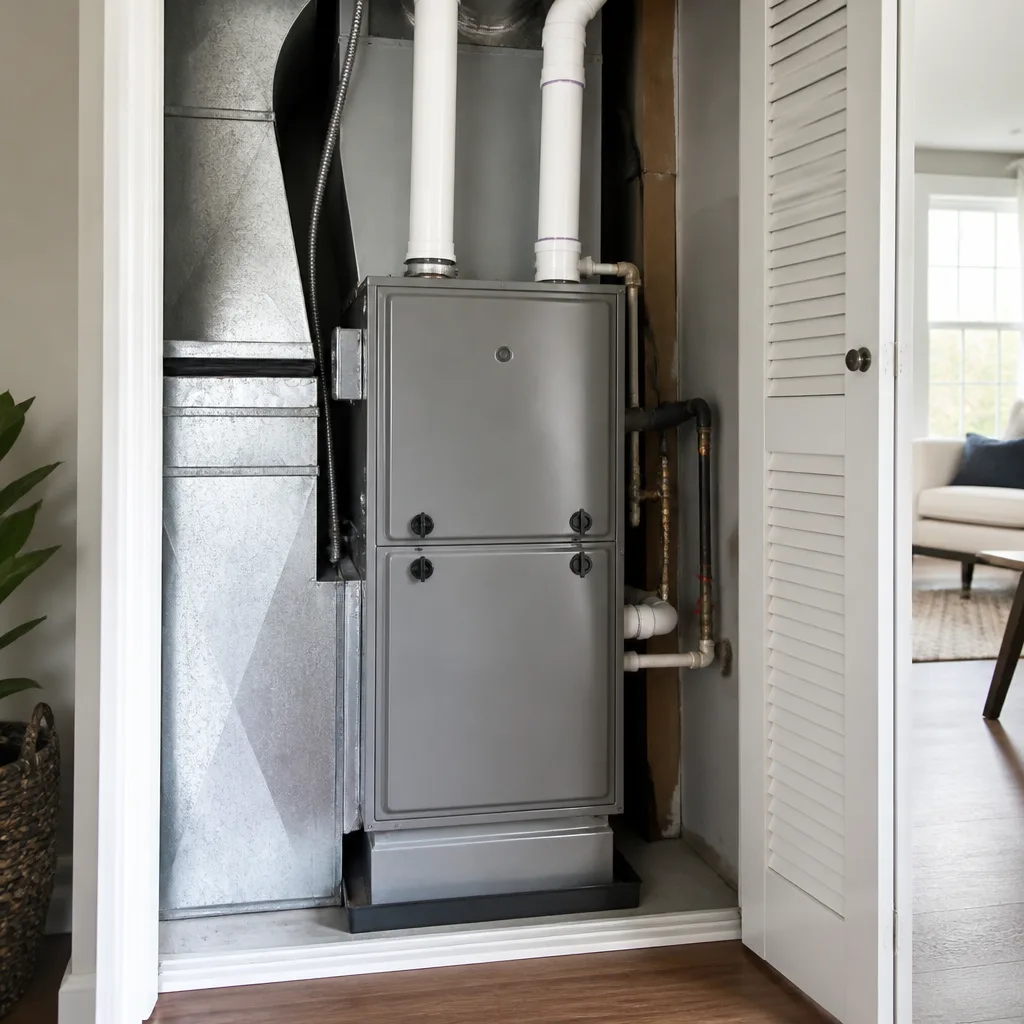 Furnace & heating
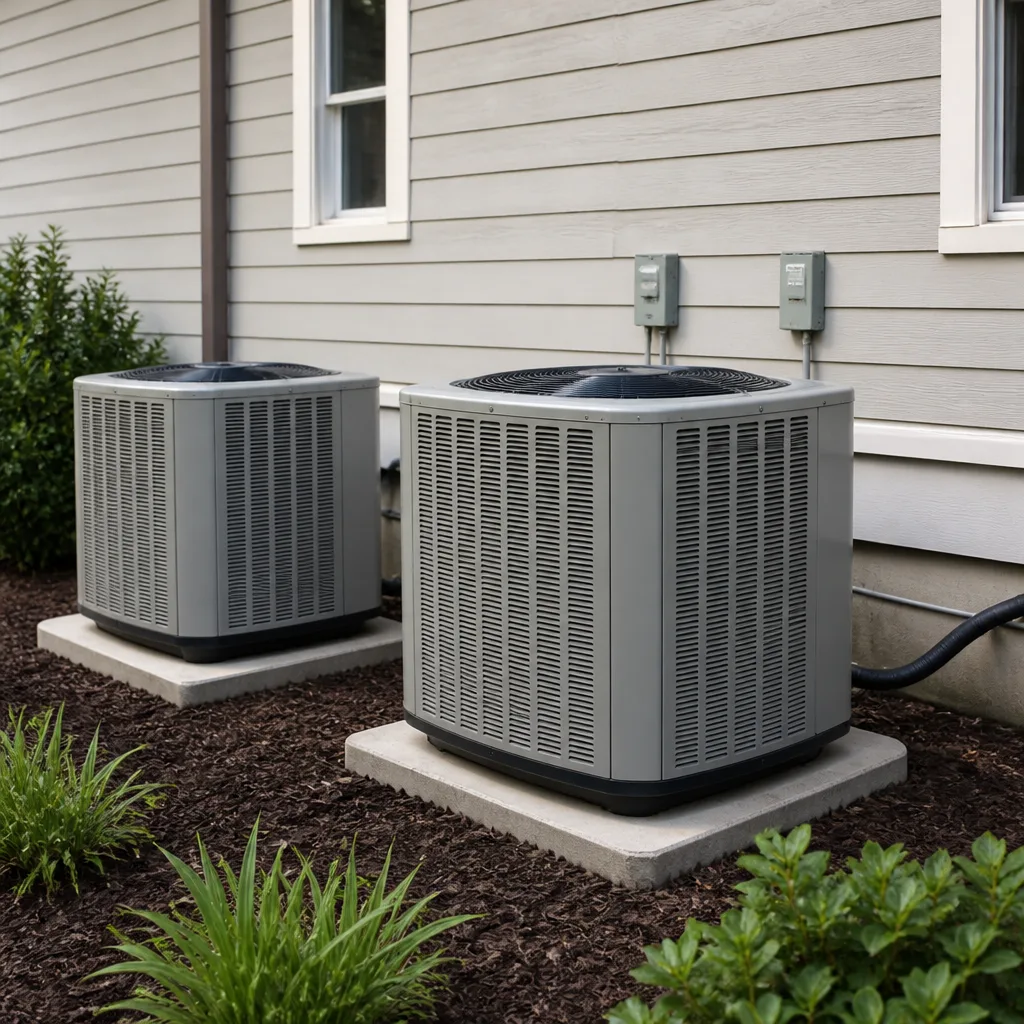 Heat pumps
 Carrier
 Trane
TraneSeasonal tune-up and full diagnostic on your Carrier, Trane, or Goodman system - readings shown to you before any repair is proposed
Diagnosis first, numbers second - you approve the repair price before a single part goes in.
Get your free estimateHow to Hire a HVAC Contractor in Miami: A Step-by-Step Guide
Florida’s Department of Business and Professional Regulation logged over 1,200 HVAC-related complaints in a single recent year, and the uncomfortable pattern in Miami is that most homeowners who got burned said the reviews looked fine. Star ratings can be bought, borrowed, or earned on small jobs, but the contractor who shows up for your full system replacement is a different person than the one who changed a capacitor. This guide will not tell you to simply “check reviews and get three quotes.” It will show you the exact license lookups, permit records, and contract terms that separate a licensed Miami HVAC contractor from the unlicensed operators working this market, and it links to HVAC Warning Signs: A Miami Homeowner’s Reference Guide for the red flags to watch at the door.
Quick Answer
To hire an HVAC contractor in Miami, verify their Florida DBPR license is active (not delinquent), confirm they pull Miami-Dade County permits on work that requires them, and get five specific items in writing before work starts: scope, equipment brand and model, permit responsibility, cleanup, and warranty length. Then compare quotes on SEER2 rating and labor warranty, not just price.
Styles & brands we work with
Table of Contents
- Step 1: Verify the Florida CAC License on the DBPR Portal
- Step 2: Check Miami-Dade Permit Records Before You Sign
- Step 3: The Five Contract Terms That Must Be in Writing
- Step 4: How to Compare Quotes That Are Not Apples-to-Apples
- Red Flags That Never Show Up in Star Ratings
- The Questions to Ask Before Anyone Opens a Tool Bag
- Common Mistakes to Avoid
- When to Call a Professional
Step 1: Verify the Florida CAC License on the DBPR Portal
Florida requires HVAC contractors to hold a Certified Air Conditioning Contractor license, abbreviated CAC, issued by the Department of Business and Professional Regulation. The license number starts with either CAC (certified, works statewide) or CACO (certified, but restricted to a specific county). Checking a license in Miami takes less than two minutes.
Here is how to do it:
- Go to the Florida DBPR website and click “Verify a License.”
- Select “Certified Air Conditioning Contractor” as the license type.
- Enter the license number or the contractor’s name.
- Read the status field carefully. “Active” means the license is current. “Delinquent” means the contractor has failed to renew, failed to pay fees, or has unresolved disciplinary action. Do not hire a contractor whose license is delinquent.
- Click on the license record and read the complaint and discipline history. This is public record and will show any formal complaints, administrative fines, or license suspensions.
In our experience at Dalton Heating & Air Miami, most Miami homeowners never perform this check. They rely on the magnetic sign on the side of a truck, and that sign is not proof of anything. We are a Dalton Heating & Air Miami home location operating under The Garrison Standard since 2003, and we are licensed, insured, and bonded. That is a fact you can verify in under two minutes on the DBPR portal, and you should verify it for every contractor you consider.
Step 2: Check Miami-Dade County Permit Records Before You Sign
A licensed contractor can still cut corners on permits, and in Miami-Dade County that corner-cutting creates a legal liability for you, not for the contractor. For the full picture on why this matters, see HVAC Permits, Codes & Inspections in FL: What You Need to Know. When a contractor replaces a condenser, air handler, or runs new ductwork without pulling a permit, the county has no record of the work. At resale, a home inspector may flag unpermitted work, and the buyer’s lender may demand it be permitted retroactively, which means opening walls or paying a fine to bring the work into compliance.
Here is how to check whether a contractor pulls permits:
- Go to the Miami-Dade County Building Department’s online permit search tool.
- Enter your property address to see all permits pulled for your property in the last several years.
- Or enter the contractor’s name to see a record of permits they have pulled across the county.
- A contractor with a long permit history is a contractor who does the job by the book. A contractor with no permit history is a red flag, especially if they claim to do full system replacements or Heat Pump Installation in Miami.
Ask the contractor directly: “Will you pull the permit for this job?” The answer you want is yes, followed by a line item on the written quote showing the permit cost. A contractor who says a permit is unnecessary on a condenser replacement is a contractor who is comfortable operating outside the rules. In Miami’s climate, a properly permitted installation is also a properly inspected installation, and the county inspector is an independent check on the quality of the work.
Step 3: The Five Contract Terms That Must Be in Writing
Most disputes between Miami homeowners and HVAC contractors come down to a disagreement about what was supposed to happen. One party says one thing. The other party says another. The homeowner has no written record, so the dispute goes nowhere. The fix is simple: get the five items below in writing before work begins, on every job, regardless of size. Dalton Heating & Air Miami writes these terms on every quote as a condition of The Garrison Standard.
1. Scope of Work
The written quote should state exactly what will be done: the equipment being removed, the equipment being installed, the work required to make the connection, and any electrical or sheet metal work included. “Replace AC system” is not a scope of work. “Remove existing 3-ton Goodman condenser and air handler, install new 3-ton Bryant condenser model 126SAN036 and air handler model FB4CNP036, reconnect existing ductwork, replace disconnect box, test and commission per manufacturer startup checklist” is a scope of work.
2. Brand and Model of Equipment
A quote that says “new 3-ton AC” without a brand and model number is a blank check. The contractor can install whatever is cheap and available. At Dalton, we service nine major residential brands: Carrier, Trane, Lennox, Goodman, Rheem, York, Daikin, Bryant, and American Standard. That brand coverage does not mean every brand costs the same, and the written quote should reflect the exact equipment you are buying, not a vague promise.
3. Permit Responsibility
The quote should state who pulls the permit and who pays for it. On a full system replacement in Miami-Dade County, the permit cost is typically a line item on the quote, and the contractor pulls the permit before work starts. If the quote does not mention permits, ask why.
4. Cleanup Obligation
The written agreement should state that the contractor will remove the old equipment, packaging, and any debris, and leave the work area as they found it. The Garrison Code, which applies to every Dalton location, requires that technicians leave the site clean on every job. You should not have to ask for this; it should be written down.
5. Warranty Duration
The quote must state the labor warranty in writing. “Manufacturer’s standard warranty” covers the parts, and even then only if the installation is registered with the manufacturer. The labor warranty, the workmanship guarantee, is separate, and it is where most contractors hide. At Dalton Heating & Air Miami, every repair carries a written guarantee for a full year. If the work fails in that time, we return at no charge. That is not a courtesy; it is the 365-Day Done Right Promise.
Step 4: How to Compare Quotes That Are Not Apples-to-Apples
A $7,000 quote and a $9,500 quote in Miami may actually be quoting the same job, or they may be quoting two completely different installations. The way to compare them is to compare the components below line by line.
SEER2 Rating
SEER2 is the current federal efficiency standard for residential air conditioning, replacing SEER in January 2023. The rating measures cooling output per watt of electricity consumed over a typical cooling season. A 14.3 SEER2 system, the current federal minimum, costs less to install than a 17 SEER2 system. A 17 SEER2 system costs less to run. Over five years in Miami, where air conditioning runs nearly year-round, the higher-efficiency system can offset a meaningful portion of the difference in installed price. A quote that does not list SEER2 is not a complete quote.
Equipment Tier
Every manufacturer makes single-stage, two-stage, and variable-speed equipment. A single-stage system is a binary machine: it runs at full speed or it is off. A two-stage system runs at a lower setting on mild days and a higher setting on hot days. A variable-speed system runs continuously at whatever speed the thermostat calls for, which improves dehumidification and indoor temperature stability. The price difference in Miami between a single-stage and a variable-speed system can be several thousand dollars. When one quote is lower, check whether the lower quote is quoting a lower tier.
Labor Warranty Length
The manufacturer’s parts warranty is typically 10 years on a registered compressor and 5 to 10 years on other components. The labor warranty is what the contractor offers, and it is where quotes diverge. A 1-year labor warranty is not the same as a 10-year labor warranty, and the 10-year coverage usually costs more. Dalton Heating & Air Miami writes the repair and labor guarantee clearly on every quote, and that is part of the written price before any work starts.
Brand Coverage
This matters for homeowners who already own a system made by a specific manufacturer. Not every contractor in Miami will service all nine major residential brands. Dalton services all nine: Carrier, Trane, Lennox, Goodman, Rheem, York, Daikin, Bryant, and American Standard. If one quote is from a contractor who does not service your brand, that quote is telling you they intend to replace your equipment whether or not it needs replacing. A contractor who cannot repair a York system is not a contractor you want quoting a York replacement.
Red Flags That Never Show Up in Star Ratings
Miami has more unlicensed HVAC operators per capita than almost any other major U.S. metro, and the standard advice of check reviews and get three quotes does not filter them out. An unlicensed operator can buy reviews, operate under a different name from week to week, and disappear when a problem surfaces. Here are the red flags that show up at the door, not on the review site.
The Quote Is Given Without Measuring the Home
A correct HVAC quote requires measuring the conditioned square footage, window area, ceiling height, insulation, and duct layout. A contractor who quotes a system size from the driveway, without walking the home, is guessing. A wrong-size system in Miami’s humid climate will short cycle and fail to dehumidify. We measure, every time. There is no other way to size a system correctly.
The Price Changes When the Crew Arrives
This is the single most common complaint in Florida DBPR files and the pattern every Miami homeowner should watch for. The written quote says one number. The crew arrives and finds “unexpected complications” that were visible from the start: a difficult air handler location, a questionable electrical connection, a duct issue that requires additional work. The price goes up. At Dalton Heating & Air Miami, the price is in writing before any work starts, on every job, without exception. That is a non-negotiable term of The Garrison Standard. If the quote changes at the door, the contractor is not operating under a standard; they are operating a bait-and-switch.
Vague Warranty Language Like “Manufacturer’s Standard”
“Manufacturer’s standard” is not a warranty. It means the contractor will refer you to the manufacturer if the parts fail, and the manufacturer’s coverage depends on whether the installer registered the equipment and whether the failure is a covered component. It says nothing about the workmanship. A proper warranty is written: the labor is guaranteed for a specific duration, and if the repair fails in that window, the contractor returns at no charge. Our AC Repair in Miami work carries exactly that: a written guarantee, in plain terms, for a full year.
No Physical Address on the Quote or the Website
An unlicensed operator often has no physical address in Miami-Dade County. The phone number rings to a cell phone. The address on the quote is a P.O. box or a UPS store. A licensed contractor has a physical place of business where you can find them if something goes wrong. Dalton Heating & Air Miami is a Garrison Partners company with a verifiable physical presence and a local office. You should be able to find the contractor’s address without digging.
The Contractor Cannot Name the Brands They Service
A legitimate contractor can tell you, specifically, which manufacturers they are trained to service. An unlicensed operator says whatever brand comes up in the conversation and hopes it is the one you own. Dalton Heating & Air Miami services nine major residential HVAC brands: Carrier, Trane, Lennox, Goodman, Rheem, York, Daikin, Bryant, and American Standard. That is not an accident of training; that is a commitment to factory-level service across the brands actually installed in Miami homes.
The Questions to Ask Before Anyone Opens a Tool Bag
The questions below are designed to separate a licensed Miami HVAC contractor from a truck with a magnetic sign. Write them down and ask them before you sign a quote.
- “What is your CAC license number?” A licensed contractor answers immediately. An unlicensed operator stumbles, changes the subject, or says the license is “in the truck.”
- “Will you pull the permit for this job?” The correct answer is yes, with the permit cost broken out on the written quote. Any answer that suggests the permit is unnecessary, or that the homeowner should pull it themselves, is a reflection of how the contractor works, not how permits work in Miami-Dade County.
- “Is the price in this quote the price I will pay if nothing changes?” A written price that covers the scope of work as described is the only answer that protects you. At Dalton Heating & Air Miami, the price is in writing before any work starts, on every job, and the only way the number changes is if you change the scope. That is not a policy; it is a requirement of The Garrison Standard.
- “Who is showing up at my door?” The company you speak to on the phone should be the company that arrives. At Dalton Heating & Air Miami, the technicians who arrive are background-checked and uniformed. You know who is coming before they arrive. On a scale of professionalism, asking who is showing up is a reasonable question and a telling one.
- “What does your labor warranty cover, and for how long?” A one-year written warranty on labor is a base standard. A 365-day promise in writing, with a free return visit if the repair fails, is the level of coverage we provide at Dalton under the Done Right Promise. If a contractor will not put the warranty in writing, the warranty does not exist.
Common Mistakes to Avoid
- Hiring the lowest quote without comparing SEER2, equipment tier, and labor warranty. The cheapest quote in Miami is often the cheapest because it quotes a single-stage system with a short labor warranty. The comfort difference and the repair exposure over five years erases the short-term savings.
- Skipping the DBPR license check. Two minutes on the Florida DBPR portal would have caught the unlicensed operator before they ever touched the system. Do not skip the only step that matters more than any review.
- Assuming the permit is the contractor’s problem. In Miami-Dade County, an unpermitted HVAC installation becomes the homeowner’s liability at resale. The county does not pursue the contractor who skipped the permit; you are the one holding the title.
- Accepting a quote that does not name the equipment. “New 3-ton AC” is not a specification. A written quote names the brand, the model, the SEER2, and the tier. Without those, the contractor can install whatever is on the truck and bill you as if it were what you agreed to.
- Trusting a review site over a license check. This point bears repeating because Miami’s unlicensed operators know how to game reviews. A license is a public record. A review is an opinion. One of these has legal consequences for being false.
- Paying the full balance before the job is complete. A deposit is normal. Full payment before the equipment runs, the permit is inspected, and the cleanup is done is not. A contractor who demands full payment up front is a contractor who has no intention of coming back if the work fails.
- Skipping the written warranty requirement. Verbal promises do not hold up. The warranty must be on paper, signed, with a clear duration. Dalton Heating & Air Miami puts the warranty in writing on every repair, covering a full year, because a promise that is not written does not exist.
When to Call a Professional
Some HVAC work in Miami is genuinely dangerous and should not be attempted without training. Refrigerant handling is regulated by the EPA and requires a Section 608 certification; a homeowner who vents refrigerant is breaking federal law and risking frostbite burns. Electrical connections at the condenser and air handler carry 240 volts, enough to kill. Gas furnace repair, covered under our Furnace Repair in Miami service, involves combustion and carbon monoxide risk that is invisible until it is too late. If the work involves refrigerant, electrical panels, gas lines, or anything inside the air handler, call a licensed professional. Dalton Heating & Air Miami offers free estimates in Miami, and the phone line at (850) 754-6042 is answered by a live person 24 hours a day, 7 days a week, including holidays. You will not get a voicemail queue or a callback window.
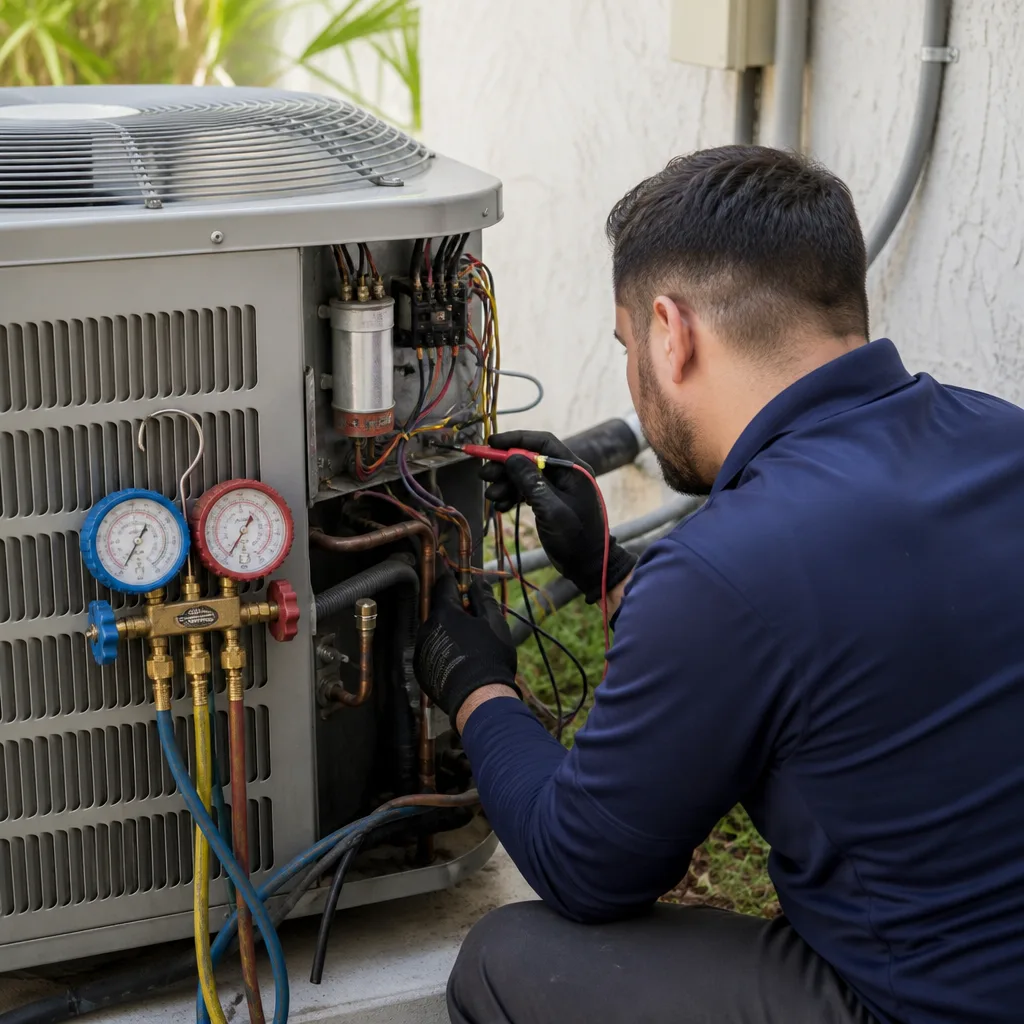
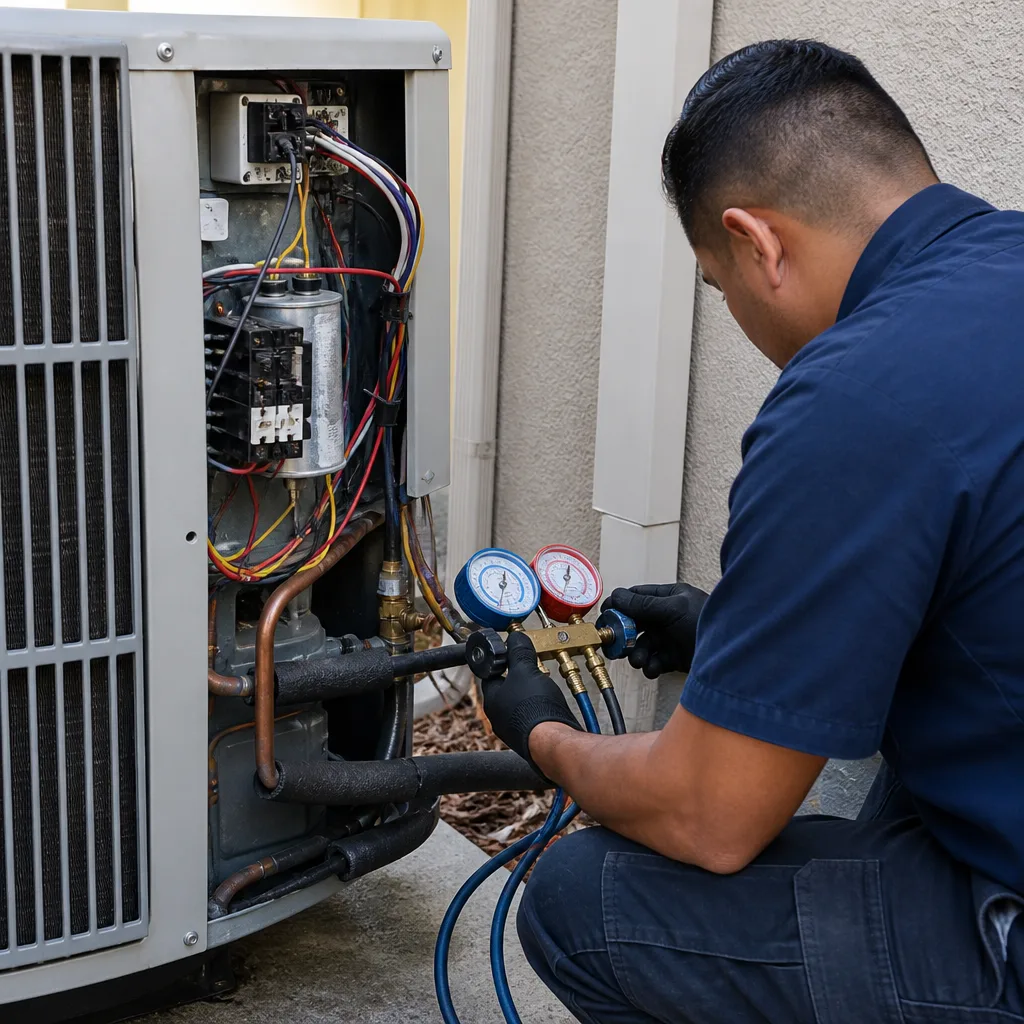
See the difference
 Before
 After
After Before
 After
After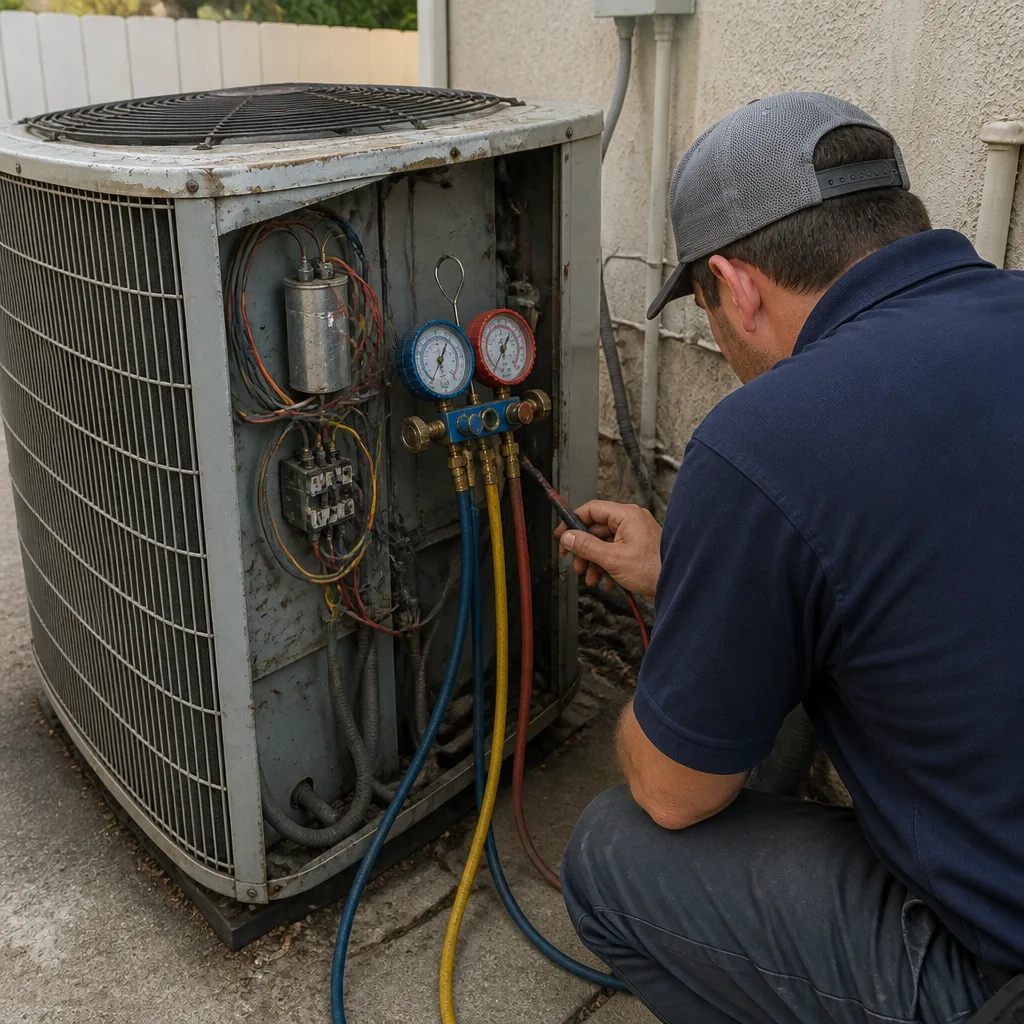 Before
 After
AfterFrequently Asked Questions
Search the contractor’s name or license number on the Florida DBPR online portal under “Certified Air Conditioning Contractor.” The status must read “Active.” A “Delinquent” status means the license has lapsed or the contractor has unresolved disciplinary action, and you should not hire them. The entire check takes under two minutes and is the single most effective screen for unlicensed operators in Miami.
Yes, a full condenser or air handler replacement requires a mechanical permit pulled by a licensed contractor in Miami-Dade County. The permit triggers a county inspection after installation, which is an independent check on the workmanship. A contractor who skips the permit leaves you with an unpermitted installation that can complicate a future home sale. Dalton Heating & Air Miami pulls permits on every job that requires one, and the permit cost is a line item on the written quote.
A full system replacement in Miami typically runs $6,000 to $12,000 installed, depending on the SEER2 rating, the equipment tier, the brand, and the condition of the existing ductwork and electrical. For a detailed breakdown of where those numbers come from, see HVAC Cost Breakdown: The Miami Homeowner’s Reference for 2026. Single-stage systems sit at the lower end; variable-speed systems with higher SEER2 ratings sit at the upper end. A written quote from Dalton Heating & Air Miami names the exact equipment, the permit cost, and the labor warranty so you can compare real numbers, not estimates.
A CAC license allows the contractor to work anywhere in Florida. A CACO license is county-specific, so a contractor with a CACO for Broward County cannot legally work in Miami-Dade. Always confirm the license covers Miami-Dade County before you hire. The license type and its geographic scope are shown on the DBPR record.
A repair makes sense for most failures under $450 on a system under 10 years old; a replacement makes sense when the repair approaches 30 percent of the replacement cost or when the system uses R-22 refrigerant, which was phased out and is now expensive to recharge. In Miami’s year-round cooling climate, a system older than 12 years that needs a major repair is usually a candidate for replacement. The written warranty on the repair also changes the math: a 365-day guarantee on a $350 repair makes that repair a low-risk bet.
A live person answers the phone at (850) 754-6042, 24 hours a day, 7 days a week. There is no voicemail queue and no callback window. That is part of The Garrison Standard, the operating discipline under which every Dalton location operates, and it applies on weekends and holidays the same as it does on a Tuesday afternoon.
The Bottom Line
Hiring an HVAC contractor in Miami is not complicated, but it is specific. Verify the Florida DBPR license is active. Confirm the contractor pulls Miami-Dade County permits. Get the scope, equipment, permit responsibility, cleanup, and warranty in writing before work starts. Compare quotes on SEER2 rating, equipment tier, and labor warranty length, not price alone. And if you call Dalton Heating & Air Miami, know that the written price, the written guarantee, and the 365-Day Done Right Promise are not optional for us; they are the way the company has operated under The Garrison Standard since 2003. For more guides & resources on protecting your home investment, explore our blog. That is the baseline, and it is what a Miami homeowner should expect from any contractor who asks for the job.
Written by Marco Benitez, Owner at Dalton Heating & Air Miami, serving Miami since 2003.